
Your municipality's mSCOA data is telling a story. Is leadership listening?
mSCOA is recording your municipality's financial story in near real time - and this edition of The Municipal Brief sets out exactly what that data already reveals and why most municipalities are not yet using it for governance.
Key Takeaways
- mSCOA is not a chart of accounts - it is a seven-dimensional governance tool. Every transaction is classified by project, function, item, fund, region, costing and standard classification simultaneously. That means every irregular expenditure, every unfunded budget, every ward-level resource allocation is already in the system. The data to prevent R40.14 billion in irregular expenditure in 2024-25 existed. The decisions didn't follow.
- Zero of South Africa's eight metros achieved a clean audit - and they collectively manage 54% of local government expenditure. The AGSA report makes clear this is not a systems failure. It is a governance failure. mSCOA gave metros the data. Leadership didn't act on it.
- The ward-level accountability infrastructure is already built. mSCOA's region segment, where coded correctly, can make spatial disparities easier to identify. Capital-project reporting includes GPS fields. Communities can track where national transfers went. The tools for genuine public accountability exist - they are just not being used.
- Incoming regulations will make system integration mandatory, not optional. The draft regulations define 14 business process groups and formalise integration requirements previously articulated in Circular 80. Standalone spreadsheet systems for assets, payroll and supply chain will not comply. Municipalities that haven't integrated are running out of time.
- Statistics South Africa will stop sending questionnaires and pull directly from the National Treasury mSCOA database. The separate submission stage - where errors could be caught - disappears. What is in the system becomes national statistics. Data quality is no longer an internal concern. It is a public record.

Business Engineering
From data architecture to governance infrastructure
Business Engineering and PhoenixERP have been working in South African local government long enough to have lived through the full arc of the mSCOA reform - from the first Circular 80 requirements through to the integrated business process regulations now approaching promulgation. That experience gives their Managing Director, Philip de Bruin, a particular vantage point on what the reform has actually delivered, and what it still requires.
The technical progress is real: ERP systems in local government are largely mSCOA compliant. Validation at source - where a wrongly classified transaction is flagged across all segments before it reaches the general ledger - has fundamentally reduced the miscalculation and incomplete records that characterised the pre-mSCOA environment. String submissions are near real time. Non-compliance is visible on the National Treasury dashboard within hours, not at year-end. Manipulation of financial data has become near-impossible for municipalities running fully integrated systems.
What de Bruin argues has not changed - and what the audit findings support - is that technology alone does not transform governance. mSCOA connects every function in a municipality through a common data language. When that language is spoken only in finance, the value stays in finance. When it is spoken across the organisation - by engineers, community services heads, supply chain managers, HR and political leadership alike - it becomes the governance tool the reform was designed to be. The forthcoming regulations make this the new standard, not an aspiration.
“When we do mSCOA properly, we will be able to report in a near real-time environment. That, in itself, is a huge improvement.”
Philip de Bruin, MD, Business Engineering
“At the heart of mSCOA are people. As a collective, we need to recognize that and invest in the people we work with. mSCOA will become a powerful tool in our quest for better corporate governance, better decision-making and ultimately better service delivery.”
Philip de Bruin, MD, Business Engineering
PhoenixERP connects billing, supply chain, assets, payroll and financial accounting through a single mSCOA-compliant data model, built to meet the integration requirements of the forthcoming National Treasury regulations. For municipalities approaching the new administration cycle, the investment case is direct: a clean system entering an election year is not a luxury. It is what makes new councils governable from day one.
mSCOA was built for compliance. South Africa’s municipalities are only beginning to use it for governance.
The Auditor-General’s consolidated local government audit report for 2024-25, tabled in June 2026, delivered a clear verdict on the outgoing administration: limited progress was made. None of South Africa’s eight metropolitan municipalities achieved a clean audit - and together they manage R335.97 billion, or 54% of total local government expenditure budget, serving approximately 24.9 million people. Irregular expenditure in the sector reached R40.14 billion in 2024-25 alone, with 77% of metro irregular expenditure over 4 years traced to procurement and contract management failures. Forty-five percent of municipalities - 116 in total - adopted unfunded budgets, up from 113 the year before. And yet, the data to detect almost all of these problems was sitting in the mSCOA system throughout.
mSCOA is not simply a chart of accounts. It is a seven-dimensional data architecture that classifies every municipal transaction simultaneously by project, function, item, fund, region, costing and standard classification. That structure means a single transaction can be interrogated from multiple angles: what was bought, by which department, for which function, in which ward, funded by which source, linked to which project. A municipality running mSCOA correctly generates, in near real time, the information needed to identify budget deviations early, flag procurement irregularities before they compound, and show communities exactly where ward-level resources went. The reform was designed to make governance visible. What the audit record shows is that the data exists - but the decisions that should follow from it are not being made.
“Compliance gave us consistency, and consistency gave us data. Now the opportunity is to extract value from that data through technology.”
Kgothatso Matlala, Economist: LG Data Management & mSCOA, National Treasury
mSCOA Webinar Series, Future Cities Africa & The Municipal Edge, 27 March 2026
Research linking National Treasury’s mSCOA dataset with spatial, demographic and governance data has produced a 15-year harmonised picture of municipal finances across all 257 municipalities - revealing operating margin trends, intergovernmental transfer impacts, service delivery gaps and own-revenue potential. The analysis is already running. Operating margins for a significant share of municipalities are negative. Preliminary analysis indicates that growth in property-rates revenue is trending downward - a concern for fiscal autonomy. Employee costs are rising as a share of total operating expenditure in district municipalities. These patterns are visible in the data. The question is whether financial leadership is looking.
At ward level, mSCOA’s region segment, where coded correctly, shows exactly where municipal resources were spent - exposing spatial inequalities and can make spatial disparities easier to identify. The function segment identifies the relevant municipal function; the segment links the transaction to the organisational vote or department. Capital-project reporting includes location/GPS fields, supporting spatial verification when accurately completed and paired with physical-progress evidence. Following tabling of the draft budget, normally by 31 March, the municipality must publish it and invite community submissions. Communities can see how national transfers translate into ward-level decisions and challenge what they see. In municipalities that are using this data, oversight has moved from opinion to evidence.
“Oversight is no longer a matter of opinion. It is a matter of evidence. The challenge is simple and urgent: move from compliance to consequence, from reporting to oversight, and from spending to public value.”
Zinzi Mphahlele, Manager: Budgeting & Reporting, City of Polokwane
mSCOA Webinar Series, Future Cities Africa & The Municipal Edge, 2 July 2026
The next phase of the reform is structural. National Treasury is preparing to promulgate updated minimum business process and system requirements - the most significant update since Circular 80 in 2016. Developed through more than 100 work sessions over two years involving municipalities, vendors, SALGA and the Auditor-General’s office, the draft regulations define 14 business process groups spanning the full municipal lifecycle: from corporate governance and IDP planning through supply chain, asset management, HR, revenue management and financial accounting. The draft regulations would formalise and update requirements previously articulated in Circular 80, and explicit integration requirements between systems are specified for the first time. mSCOA Chart Version 7.1, released with Circular 132 in December 2025, is already in effect for the 2026/27 financial year. Standalone spreadsheet-based systems for assets, payroll and supply chain will not meet what the new regulations require.
A municipality that achieves genuine system integration - one source of truth, real-time data exchange, no manual intervention between departments - creates the foundation for substantially more powerful applications: revenue forecasting, procurement anomaly detection, budget deviation alerts, and real-time service monitoring. These are not future aspirations. They are the downstream benefits of getting mSCOA data quality right, today. National Treasury’s mSCOA Technical Advisor makes clear that governance structures are what either enable or prevent this: multidisciplinary steering committees - not just finance and ICT, but every head of department - must be kept active. And councillors must be carried through the entire implementation journey, not consulted only when a budget needs to be approved.
“If we are only involving councillors when they need to approve a budget, we are heading for disaster. They must be carried through the entire journey.”
Thina Naki, mSCOA Technical Advisor, National Treasury
mSCOA Webinar Series, Future Cities Africa & The Municipal Edge, 2 July 2026
This matters most right now because new councils will take office on 4 November. Many incoming councillors will have limited familiarity with mSCOA. The municipalities that have maintained active governance structures, integrated their systems and kept their data clean are the ones where a new council can get to work quickly. The municipalities that did not invest in the reform will spend the first months of the new term trying to understand a financial picture that mSCOA was always supposed to make transparent.
From the Continent
The mSCOA standard is ahead of most of the continent - and the gap between design and use is the same challenge everywhere
South Africa’s mSCOA is one of the most granular municipal financial standardisation frameworks in Africa. Most local governments on the continent still report to national government through processes that allow substantial variation in how transactions are classified, limited comparability between entities, and significant time lags before financial data reaches oversight bodies. The structural advantage South Africa holds is real: near real-time transaction-level data, classified by a seven-dimensional standard, flowing to National Treasury from 257 municipalities simultaneously.
The challenge South Africa is navigating now - moving from data submission to data use, from compliance to governance - is one that other countries will face as their own standardisation efforts mature. The lesson from the South African experience is already clear: the technical architecture, however advanced, is only the precondition. The governance question - whether leadership uses the data, whether oversight structures ask the right questions, whether consequences follow when the data reveals a problem - is separate from the technology. And it is harder.
The Forward View
Statistics South Africa has confirmed it will stop sending quarterly financial questionnaires to municipalities from the next financial year, extracting data directly from National Treasury’s mSCOA database instead. The administrative burden on municipalities decreases. But the quality premium rises: there is no longer a separate submission stage where errors can be caught and corrected. What is in the system is what reaches national statistics - and what informs policy.
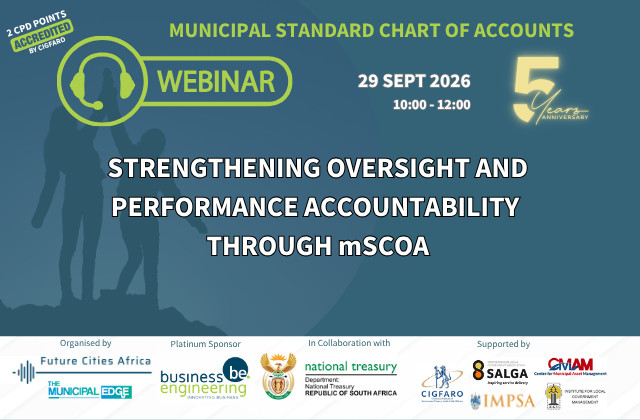
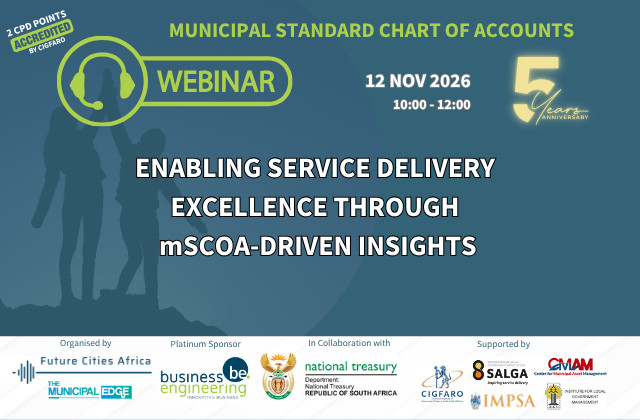
At the same time, new councils elected on 4 November will step into an oversight framework built on data they will need to understand quickly. The 29 September webinar in this series is focused precisely on equipping them - alongside MPACs, audit committees and municipal executives - with the practical approaches needed to use mSCOA data for real oversight: testing budget credibility, connecting expenditure to service delivery, and making accountability traceable. The fourth and final session in the series follows on 12 November 2026.
The compliance foundation remains incomplete in many municipalities; compliance and governance use must now improve in parallel. The governance phase starts now - with an election, a new set of councils, and the data to hold all of them accountable sitting in the system, waiting to be used.
Upcoming Webinars

Recommended Podcasts

