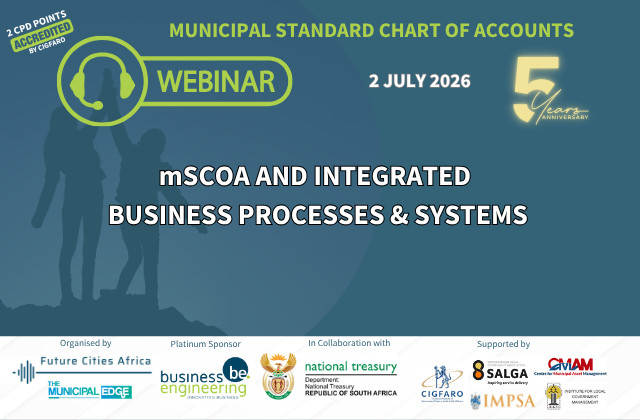
Enabling Service Delivery Excellence through mSCOA-Driven Insights
Future Cities Africa and the Municipal Edge in collaboration with National Treasury present the '"Municipal Standard Chart of Accounts" Webinar Series.
Stay Connected
mSCOA Series - Webinar 4 of 2026
Enabling Service Delivery Excellence through mSCOA-Driven Insights
Hosted by: Future Cities Africa and The Municipal Edge, in collaboration with The National Treasury of South Africa
Platinum Sponsor: PhoenixERP by Business Engineering
Date: 12 November 2026
Topics: mSCOA as a Business Reform - Financial Accountability Cycle - Infrastructure Planning - Maintenance and Asset Management - In-Year Reporting - Finance and Technical Services Integration - Project Management Module - Asset Registers
mSCOA compliance is not the destination - it is the starting point. This webinar, the final in the 2026 Local Government Conversations series, brought together budget and finance managers with a technical services official to make a case that has been building across the entire mSCOA series: a municipality can spend its full budget, submit every report on time, and still fail to deliver what communities need. The question mSCOA should be answering is not whether money was spent - it is whether the money delivered results.
Practitioners from the City of Polokwane and Alfred Duma Local Municipality demonstrated what that looks like in practice: linking financial information to physical implementation through joint project reviews, using mSCOA trial balances to identify operational warning signs, and building the case for linking maintenance expenditure directly to asset registers so that repair history informs future planning rather than sitting in disconnected systems. The reform thread running through all four speakers was consistent: mSCOA is a business reform, not a finance reform. That means it belongs to technical services, supply chain, asset management and IDP teams as much as it belongs to the CFO's office. The upcoming gazetting of minimum business process and system requirements makes this institutional shift urgent.
Speaker contributions
Ms Zinzi Mphahlele - Manager: Budget and Reporting, City of Polokwane
Zinzi walked through the full municipal financial accountability cycle - from IDP through budget, SDBIP, in-year reporting and annual financial statements - to show how mSCOA provides the common classification thread that should connect every stage. Her central argument: financial performance and service delivery performance are not the same thing, and the reform is only delivering if the information it generates closes that gap.
- The IDP is not a statutory document to be produced because legislation requires it - it is the municipality's development blueprint. mSCOA alignment must begin at the planning and project conceptualisation stage, before budget compilation, because the quality of classification at that point determines the quality of everything that follows.
- When a capital project shows 80% financial expenditure but only 40% physical completion, the financial report is not telling the full story. Finance must interrogate the numbers; technical services must provide verified physical progress. Neither department can answer the community's question alone.
- A payment certificate is evidence of financial progress. It is not on its own evidence of improved service delivery. Reporting must move beyond expenditure percentages to demonstrate the relationship between money spent, infrastructure constructed, and service delivered.
- The region segment is underutilised. When applied consistently, it allows municipalities to track where public funds are being invested geographically, align capital budgets with the spatial development framework, and demonstrate to ward councillors and communities that spending is addressing spatial inequalities.
- The National School of Government has mSCOA training available for both finance and non-finance officials. With regulations on minimum business processes imminent, officials who are not conversant with the reform will find their municipalities wanting.
"We must move from asking whether our municipalities are mSCOA compliant to asking whether we are using mSCOA information effectively. Compliance is key - but it is not the ultimate objective. The ultimate objective is to strengthen financial management and improve service delivery."
Mr Tshiamo Mphaga - Acting Manager: Water and Wastewater Operations and Maintenance, City of Polokwane
Tshiamo brought the technical services perspective to a conversation that is usually dominated by finance. His contribution demonstrated why the finance and operations divide is the central management problem the reform must solve - and what it looks like when joint reviews are institutionalised.
- Municipalities frequently experience recurring pump failures, sewer blockages, mechanical breakdowns and emergency maintenance requirements. These costs keep rising while service reliability declines. The question management should be asking is not how much was spent, but whether the expenditure is addressing the underlying operational problem or simply keeping failing infrastructure running.
- Polokwane's wastewater treatment plant was designed for 36 megalitres per day and now receives significantly higher volumes due to population growth. The municipality needs to link expenditure on that facility to specific maintenance activities, equipment refurbishment and chemical costs - and ask whether that spending is addressing the capacity constraint or just managing the symptoms.
- The city's new Seshego Water Treatment Plant demonstrates a different lesson: completed infrastructure does not automatically guarantee service delivery. Qualified personnel, reliable raw water supply, operational inputs and maintenance arrangements must all be in place before the investment translates into service.
- Polokwane has an asset steering committee that meets monthly, bringing together finance, technical services, supply chain, asset management, the IDP team and performance management. The city has also shifted from quarterly to monthly reporting on project milestones, which allows corrective action to be tracked in real time rather than after the fact.
- Procurement constraints, financial constraints, capacity constraints and execution constraints each require a different response. mSCOA's project management module helps identify which constraint is causing a delay - but only if it is being used alongside procurement records, work orders and operational data.
"We must move away from reactive maintenance approaches towards preventative and planned maintenance, with condition-based maintenance being key. We cannot continue prioritising new infrastructure while allowing existing infrastructure to deteriorate."
Ms Irisha Gajadhur - Manager: Budget and Internal Control, Alfred Duma Local Municipality
Irisha focused on the gap between mSCOA's current capability for classifying maintenance expenditure and what it would need to do to truly support infrastructure lifecycle decisions - and proposed a practical step toward closing that gap.
- mSCOA already classifies maintenance expenditure by infrastructure category and type - distinguishing preventative maintenance from corrective maintenance, and interval-based from condition-based. The budget split between these categories is itself a management decision that requires finance and technical services to agree at the start of the year.
- The gap is that mSCOA expenditure cannot currently be linked to a specific asset on the asset register. A maintenance budget for roads infrastructure in a ward shows the amount spent - but not which road was maintained, with what materials, by which contractor, and to what result.
- If payments were linked to specific assets by barcode or asset ID, the municipality would over time build a repair history for each asset: what was done, when, at what cost, and what condition the asset is in now. That history is exactly what is needed to decide whether continued repair remains economically justified or whether renewal or replacement would deliver better lifecycle value.
- Alfred Duma uses Section 71 reports and quarterly SDBIP reviews to identify projects that are falling behind. When a delay is identified, finance, supply chain and technical services meet to determine whether the cause is a procurement issue, a contractor performance issue or a site delay - and whether a contract penalty, a budget adjustment or a process change is the right response.
- The infrastructure plan should be integrated on the financial system alongside the asset module. Without that integration, the link between what is planned, what is funded and what is physically delivered remains manual and fragile.
"If we can link maintenance expenditure per asset ID to the asset register, it will enable the technical and finance departments to perform a historic overview of the maintenance of the asset over its lifecycle - in comparison to its current condition and useful life - and make informed decisions about whether to continue maintenance or invest in renewal."
Mr Cornel Ebersohn - Project Director, PhoenixERP
Cornel connected the practitioner contributions to what a well-integrated mSCOA environment should actually do for management: detect problems while there is still time to act, trace root causes, assign ownership and track whether corrective action worked.
- Budget phasing is where most projects set themselves up for failure. Dividing a project budget evenly across 12 months guarantees 12 months of deviation explanations. Budget phasing must follow the procurement plan - there is no basis for allocating budget to a project in months one to five if the appointment is not expected until November.
- Financial data, operational data and service delivery data must be read together. The financial view answers how much was committed and where. The operational view answers what was physically completed and whether it is functioning. The service delivery view answers what changed for residents. All three are needed before any management conclusion can be drawn.
- Municipalities measure the same outputs differently - electrical connections per connection, kilometres of line built, budget spent. Circular 88 addresses this for electrification by standardising on connections made. The same standardisation is needed across other service areas so that progress is comparable between municipalities and verifiable by external oversight.
- Consumer service request portals generate geographic density data that shows in real time where infrastructure failures are clustering. This is a management intelligence tool that is already running in some municipalities - the question is whether it is being read alongside mSCOA financial data or in isolation.
- mSCOA is not yet part of routine management in most municipalities. The foundation must be in place - segments, regions, assets, process integration - before the reform can deliver its intelligence value. Shared ownership across finance, technical services, supply chain, IDP and performance management is the institutional condition that makes that foundation work.
"The objective is not to explain what went wrong. It is to prevent it from happening again. Clear ownership of classification, phasing and output verification, backed by integrated systems and joint monthly reviews, turns reporting into action."
Key takeaways for practitioners
- Financial expenditure and service delivery performance are not the same thing. A municipality can achieve 80% expenditure on a capital project while delivering 40% of the intended infrastructure. In-year reporting must track both - and finance and technical services must review that information jointly every month, not separately at year-end.
- mSCOA alignment must begin at the IDP and project conceptualisation stage. If projects are incorrectly classified at the point of identification, no amount of year-end correction recovers the data integrity. The classification question - what is this project, where will it be delivered, what type of intervention is it - must be answered before the budget is compiled.
- Budget phasing must follow the procurement plan, not the calendar. Allocating budget evenly across 12 months for a project that cannot start until a contractor is appointed in month six creates automatic deviations that consume management time without producing corrective action.
- Maintenance expenditure classified under mSCOA does not currently link to specific assets on the asset register. Linking maintenance payments to individual assets by barcode or asset ID would, over time, build the repair history needed to make credible decisions about whether continued maintenance, upgrade or replacement is the most economical option.
- mSCOA's project management module distinguishes procurement delays from capacity constraints, cash flow problems and contractor execution failures. Each requires a different intervention. The module only delivers this diagnostic value if it is being used alongside work orders, SCM records and operational reports - not read in isolation by the finance department.
- Minimum business process and system requirements for mSCOA are about to be gazetted. Officials and managers across all departments - not only finance - should be building familiarity with the reform now. Free training is available on the National School of Government portal for both finance and non-finance officials.
- The reform is everyone's business. The 42% of respondents who said finance and technical services do not review information together are describing the institutional problem the reform cannot solve from the finance side alone. Joint monthly reviews, shared ownership of project classification, and a common understanding of what the data means are organisational decisions that management must make - and the new council cycle is the right moment to make them.
CPD points available - contact cpd@cigfaro.co.za
Series partners: CIGFARO - SALGA - Centre for Municipal Asset Management - Institute for Local Government Management - IMPSA