Municipal year-end: what locks in, what opens up, and what to do now
With 11 days left in the 2025/26 financial year, this edition of The Municipal Brief lays out exactly what locks in on 30 June, why it is not just the CFO's problem, and the practical checklist municipalities and suppliers need to close the books from a position of strength rather than clean-up.
Key Takeaways
- None of the four metros reviewed by the Auditor-General achieved a clean audit for 2024/25, and the numbers behind that finding are stark: R236.3 billion in unauthorised, irregular, fruitless and wasteful expenditure for 2023/24, with Section 216(2) of the Constitution invoked against 75 municipalities and 88 carrying unfunded budgets.
- The final billing run of the financial year is the point of no return for debtor age analysis. Once it locks on 30 June, every unreconciled item in cash book, debtors, creditors, payroll and stores becomes part of this year's numbers - not next year's clean-up.
- Communities, businesses and government departments collectively owe municipalities R427 billion for services already rendered, while municipalities themselves owe roughly R120 billion to Eskom and water boards. SALGA's message to councillors is direct: interrogate revenue reports, enforce credit control, and ensure consequence management.
- Three ratios lock in on 30 June and define the difference between strength and clean-up: revenue collection of at least 95%, salary costs no more than 35% of operating expenditure, and repairs and maintenance spending of at least 8% of asset replacement value - the same golden thread benchmarks from MFMA Circular 71.
- Two regulatory changes converge on this year-end: the revised GRAP 104 expected credit loss model applies for the first time to FY2025/26 annual financial statements, and mSCOA Chart Version 7.1 takes effect with the new financial year on 1 July - making debtor write-off decisions in these final days matter twice over.

PhoenixERP by Business Engineering
Business Engineering (BE) is a South African technology and implementation company specialising in Enterprise Resource Planning (ERP) solutions, Artificial Intelligence (AI), mSCOA compliance, mobile citizen engagement applications, electronic records management, workflow automation, and document management solutions for local government. PhoenixERP, BE’s flagship local government financial management system, was designed and developed specifically for the unique requirements of South African municipalities and is fully aligned with the requirements of the Municipal Finance Management Act (MFMA).
Municipal year-end is where system readiness either delivers value or exposes risk. The reconciliations, debtor write-offs and commitment clean-ups required to close FY2025/26 correctly feed directly into two critical developments: the revised GRAP 104 expected credit loss calculation, which applies for the first time to the FY2025/26 annual financial statements, and the implementation of mSCOA Chart Version 7.1, as prescribed by MFMA Circular 132, which becomes effective with the FY2026/27 budget on 1 July.
PhoenixERP supports the entire municipal finance value chain within a single, integrated platform, encompassing IDP-based planning, budgeting, revenue management, supply chain management, asset management, payroll and human resources, and statutory MFMA reporting. Built-in controls and automated processes are designed to support a disciplined year-end close while ensuring that municipalities enter the new financial year with a fully configured and operational environment from day one.
Municipalities that view 1 July readiness as an integral part of the year-end close, rather than as a separate exercise, are invariably the municipalities that return to business fastest, maintain compliance with confidence, and position themselves for improved audit outcomes and stronger financial governance.
What Locks In on 30 June - and Why It’s Not Just the CFO’s Problem
At an April 2026 briefing to SCOPA, the Auditor-General reported that not one of the four metros reviewed had achieved a clean audit for 2024/25. The national context sits behind that finding: Treasury’s 2026 Budget Review recorded R236.3 billion in unauthorised, irregular, fruitless and wasteful municipal expenditure for 2023/24 - R81.6bn unauthorised, R137bn irregular, R17.7bn fruitless and wasteful - with Section 216(2) of the Constitution invoked against 75 municipalities to halt transfers, and 88 municipalities carrying unfunded budgets. None of these numbers were decided in the month they were reported. They were built in the closing weeks of the financial years that produced them - in the reconciliations that were or weren’t done, the write-offs that weren’t processed, the commitments that weren’t cleared. With 11 days left until 30 June 2026, those same decisions are being made right now - and the municipalities that get them right are the ones that start the new financial year from a position of strength, not clean-up.
The final billing run of the financial year is the point of no return for the debtor age analysis - once it locks, every reconciling item left in the cash book, debtors, creditors, payroll and stores subledgers becomes part of this year’s numbers, not next year’s clean-up. The same applies to outstanding orders and commitments: anything material left open at year-end either gets accrued correctly or becomes next year’s awkward “prior period” conversation with the auditors. A careful read of the income and expenditure statement in these final days - looking specifically for misallocations and anything that resembles unauthorised expenditure. Debtor write-offs that have been sitting in a queue need a decision before 30 June, not after - the revised GRAP 104 expected credit loss model applies for the first time to this year’s annual financial statements.
None of this is only the CFO’s problem - and the institution that has been saying so most loudly recently is SALGA. At a conference on “The Oversight Role of Councillors in Revenue and Debt Management” in March, SALGA put the scale of the challenge in plain terms: roughly R427 billion owed to municipalities for services already rendered, against roughly R120 billion that municipalities themselves owe to Eskom and water boards. SALGA’s message to councillors at the conference was direct: rigorously interrogate revenue reports, enforce credit control measures, and ensure consequence management where failures occur. The next 11 days are a legitimate moment for Mayors, MMs and Councillors to ask exactly those questions of their finance teams.
Municipalities implement procurement cutoffs in the final weeks of June, clearing commitments and closing the books before the new financial year opens. National Treasury has allocated R12.3 billion in new grant funding for bulk water and municipal infrastructure projects for FY2026/27, part of a R1 trillion national infrastructure pipeline that includes R156 billion for water and sanitation alone, with the R54 billion Metro Trading Services Reform incentive we covered in Issue #1 forming part of that push.
Two things converge at this year-end. mSCOA chart version 7.1, introduced via MFMA Budget Circular 132 (December 2025) for the 2026/27 MTREF, brings updated chart-of-accounts requirements that take effect with the new financial year. And the revised GRAP 104 expected credit loss standard - effective for reporting periods beginning on or after 1 April 2025 - applies for the first time to the FY2025/26 annual financial statements municipalities are closing right now, which is exactly why the debtor reconciliation and write-off decisions made in these final weeks matter twice over.
Before You Go - This Week’s Checklist
Your 30 June checklist
A practical guide for finance teams, municipal leadership, and suppliers.- Complete subledger reconciliations before the final billing run. Cash book, debtors, creditors, stores, payroll - if these aren’t reconciled going into June month-end, the problem carries through into the new year. Once the final billing run happens, the age analysis is locked. The only adjustment possible after that is unbilled water or electricity.
- Review and cancel significant outstanding orders. Minor differences can be left - but significant outstanding orders hold budget and can block year-end journals. Review them deliberately and cancel anything material before the books close. Don’t waste time on a two-rand variance; do spend time on a R20,000 order sitting unresolved.
- Go through the I&E statement - including the commitments column. There shouldn’t be open commitments at year-end. Look for incorrect allocations, budget abnormalities, and anything that resembles unauthorised expenditure.
- Get debtor write-offs into the system before the billing run closes. The revised GRAP 104 expected credit loss model applies for the first time to this year’s annual financial statements. Write-offs not in the system before month-end will delay the finalisation of the year-end close.
- For Mayors, MMs and Councillors: SALGA has been clear - interrogate revenue reports, enforce credit control measures, and ensure consequence management where failures occur. The final days of June, before the books close, are the moment to do it.
- If you supply to municipalities: submit outstanding invoices before your client’s procurement cutoff. Municipalities set hard deadlines on new orders and invoice capture in the final weeks of June - anything that misses the cutoff moves to the July payment queue, not this year’s books.
From the Continent
Mbabane, Eswatini
A regional capital’s billing-first approach to revenue recovery
At the same SALGA conference, Gciniwe Fakudze, CEO of the City of Mbabane in Eswatini, presented an action plan worth a look as South African municipalities head into their own 1 July reset: improving billing accuracy, aligning tariffs with the true cost of supply, investing in smart metering and infrastructure, and strengthening community engagement around payment culture. It’s a useful frame for the reset ahead - the billing-data integrity issue at the heart of the GRAP 104 debtor impairment model isn’t just an accounting compliance question. Treated properly, it’s a revenue strategy. (Source: The Witness, 4 March 2026)
The Market View
The procurement cutoff is a pause, not a full stop - and the new year opens with the largest water infrastructure funding allocation in years.
For private-sector suppliers and service providers, the next two weeks will likely feel quiet - that’s the year-end procurement cutoff, not a loss of appetite. The opportunity sits just on the other side of it. SONA 2026 confirmed R1 trillion in public infrastructure investment over the next three years, with R156 billion for water and sanitation as the largest single allocation - including a R54 billion metro incentive designed to push urban municipalities to accelerate their own water, sanitation and electricity reforms, echoing the Metro Trading Services Reform theme covered in Issue #1. Within that, Treasury has already allocated R12.3 billion through the Regional Bulk Infrastructure Grant and Water Services Infrastructure Grant to fund 70 bulk water projects and 341 water services initiatives for FY2026/27. For firms in municipal systems, financial advisory, and infrastructure delivery, the practical takeaway is timing: use the quiet fortnight to prepare, and be ready to engage from the first weeks of the new financial year, when new-year budgets, tender cycles and capital programmes open. (Source: Green Building Africa / SAnews, May 2026; SONA 2026 via IOL/Business Report, 25 Feb 2026)
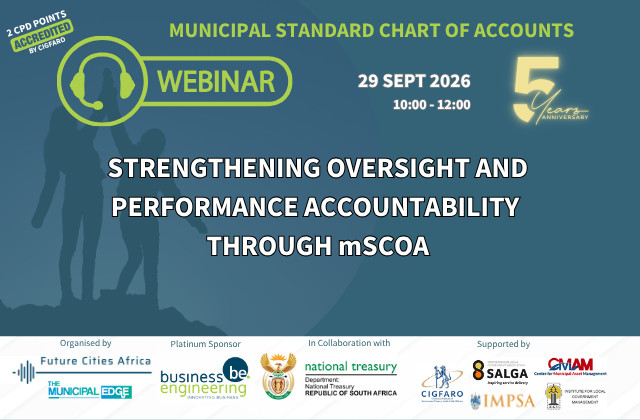
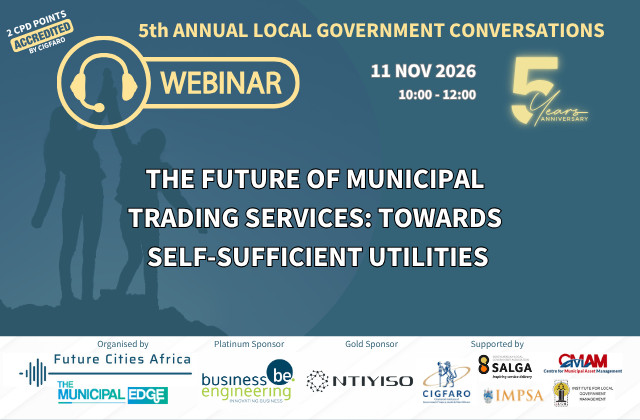
Upcoming Webinars

Recommended Podcasts

