R54 billion is on the table. Does your municipality have the data to claim it?
National Treasury of South Africa has put R54 billion on the table for metro reform in South Africa. But access is conditional on measurable performance. That proof has to come from data - and that's where mSCOA stops being a compliance exercise and starts being a governance tool.
Also in this issue: 63% of municipalities in financial distress, the AG dispute with SA's three biggest metros, what Kigali's digital government model means for African cities, and four sector signals from across the continent.
Key Takeaways
- National Treasury has made R54 billion available to South Africa's eight metros - but it is conditional on meeting 8 accountability commitments and independently verified annual performance targets across governance, finance and operations.
- mSCOA is no longer a compliance exercise - it is the data infrastructure that will determine whether metros qualify for conditional funding. The three largest metros (Cape Town, Johannesburg, Ekurhuleni) are already in audit limbo after missing the January 2026 MFMA deadline.
- 63% of municipalities are in financial distress, only 16% achieved clean audits in 2023/24, and 47.3% of treated water nationally generates no revenue - the numbers behind the crisis are stark and getting worse.
- The energy crisis has shifted: 328 days without national load shedding, but Joburg high-voltage outages are up 15% in the same period. The problem has moved from generation to municipal distribution networks.
- Rwanda's Irembo platform - one portal for 100+ government services - offers South African metros a lesson not in technology but in institutional will: the real barrier to digital transformation is the discipline to retire fragmented legacy systems, not the availability of better ones.

Business Engineering
"The era of mSCOA as a compliance exercise is behind us. ERP systems are largely there - the challenge now is consistent use and data accuracy at the point of capture. That is where the real governance value is unlocked."
- Philip de Bruin, Managing Director, Business Engineering · Featured panellist, this issue's webinar
Business Engineering works with South African municipalities and government institutions on ERP systems, mSCOA implementation, and financial management solutions.
Treasury has availed R54 billion and made it conditional on achieving minimum commitments. That also brings in the importance of mSCOA.
On 18 March 2026, National Treasury launched the Metro Trading Services Reform programme - a six-year, R54 billion conditional support package for South Africa's eight metros. The word that matters most in that sentence is conditional. Metros will only access the funding if they commit to 8 minimum accountability commitments and achieve annual performance targets across three results areas: accountability, financial, and operational performance - independently verified each year. The reform covers electricity, water, sanitation, and waste services, but the entry ticket is institutional and governance reform first. That requires proof. And that proof has to come from data.
This is the moment mSCOA stops being a compliance exercise and starts being a governance tool. The seven-dimensional data framework that municipalities have been building since 2017 - mapping every transaction across project, function, region, item, fund, costing, and standard classification - is now the infrastructure and part of tools that will be used to justify whether a metro deserves or qualifies for conditional funding. The AG's ongoing dispute with Cape Town, Johannesburg, and Ekurhuleni, which has left the three largest metros in audit limbo after missing the January 2026 MFMA deadline, shows precisely what happens when that data chain breaks down. The data isn't a back-office function anymore. It's a strategic asset.
From the Continent
Kigali, Rwanda · Digital Government
One front door for 100+ government services - and what SA metros can learn from it
Rwanda's Irembo e-government platform gives residents access to over 100 government services online - from business registration to driver's licence renewals - through a single authenticated portal. Kigali's rise in African smart-city rankings was not driven by scattered technology pilots, but by the institutional discipline to retire fragmented legacy systems and consolidate them into one citizen front door. For South African metros still running separate portals for billing queries, rates clearances, building plans, and indigent registration, the lesson is less about the technology and more about the will to sunset what came before. (Source: Rwanda Ministry of ICT Smart City Masterplan; UN-Habitat)
The Market View
Conditional funding is a procurement signal - and the clock is running.
Treasury's R54 billion conditional metro programme is as much a market signal as a policy one. For ERP vendors, systems integrators, revenue management firms, and data analytics providers, it creates a visible demand pipeline: metros that want the funding need to demonstrate measurable data quality and service delivery outcomes, and that requires fit-for-purpose systems. With the 2026 local government elections now confirmed for November 2026 – February 2027, councils are effectively on a six-month clock for capital projects and strategic procurement. Companies with a track record in municipal data, revenue enhancement, or smart metering are best positioned to move now, before the pre-election paralysis sets in.
Upcoming Webinars
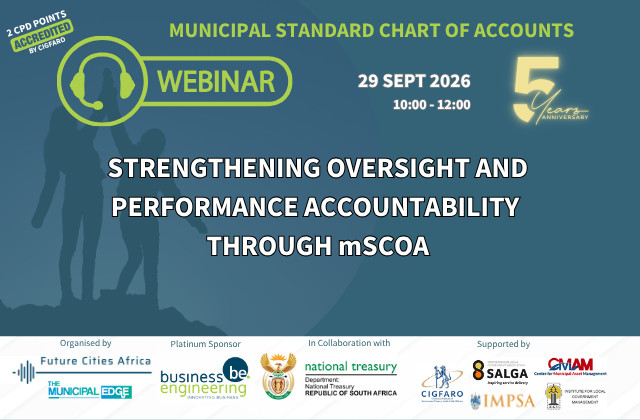

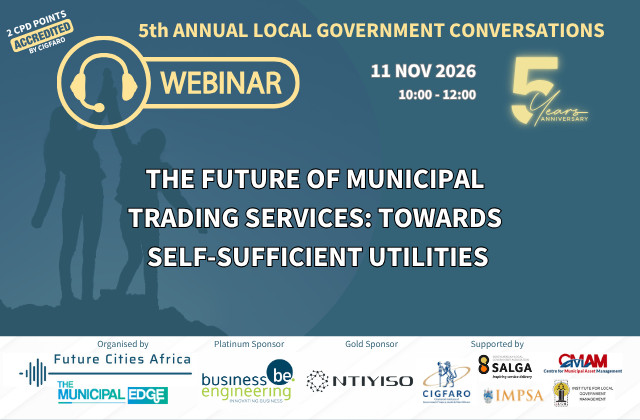
Recommended Podcasts