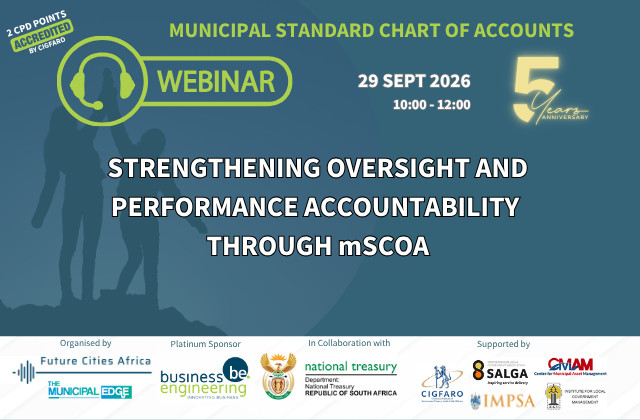
Strengthening Oversight and Performance Accountability through mSCOA
Future Cities Africa and the Municipal Edge in collaboration with National Treasury present the '"Municipal Standard Chart of Accounts" Webinar Series.
Stay Connected
Context and background
The Municipal Standard Chart of Accounts (mSCOA) establishes a uniform framework for classifying municipal budget and financial information at transaction level. Municipalities are expected to budget, transact and report within that framework, enabling more consistent information across planning, implementation and reporting cycles. National Treasury describes mSCOA as a business reform that can improve comparability, transparency and the quality of information available for oversight. mSCOA must not merely be viewed as a compliance exercise or tool.
The value of the reform is realised only when reliable data reaches the people who must act on it. Citizens and communities, councils, Municipal Public Accounts Committees (MPACs), audit committees, executive leadership and municipal management need timely, reconciled and intelligible information to test budget credibility, interrogate deviations, assess control effectiveness and connect expenditure to institutional performance and service delivery.
National Treasury's in-year reporting requirements, as outlined in the Municipal Finance Management Act, can be easily fulfilled as mSCOA data provides early warning and oversight of municipal financial performance. However, data credibility issues - including incorrect classification, offline spreadsheet workarounds and weak period controls - can undermine the reliability of that information. This creates a practical governance challenge: municipalities may have large volumes of data without a disciplined route from signal to scrutiny, decision, correction and outcome.
This webinar shifts the conversation from whether municipalities submit mSCOA information to how they use it. It will surface practical municipal experience, demonstrate the questions different oversight structures should ask, and identify the enabling disciplines - data ownership, system integration, reconciliations, evidence trails, consequence management and cross-functional collaboration - that make accountability real.
Purpose
The purpose of the webinar is to equip municipal political office-bearers, oversight structures, officials and various stakeholders with practical approaches for using mSCOA data to strengthen governance, improve performance accountability and support better decisions across the municipal planning, budgeting, implementation and reporting cycle.
Webinar objectives
The webinar will focus on the following interrelated pillars:
- Reframe mSCOA as a management reform: Demonstrate how standardised transaction data can support institutional management, not only regulatory submissions.
- Strengthen oversight practice: Clarify the information and questions that councils, MPACs and audit committees need to discharge their distinct mandates.
- Connect money to performance: Show how financial information can be linked to the Integrated Development Plan, Service Delivery and Budget Implementation Plan, performance indicators and service delivery evidence.
- Improve assurance and audit readiness: Identify controls and routines that improve completeness, accuracy, traceability, reconciliation and the quality of supporting evidence.
- Translate learning into action: Provide practical takeaways that municipalities can apply to dashboards, committee packs, management reviews and corrective-action tracking.
Themed topics
- Oversight that uses data, not data dumps: What concise views, exception reports and trend analyses help council, MPAC and audit committee members distinguish material risks from routine variance? How should questions, decisions and follow-up actions be recorded?
- Linking mSCOA to performance frameworks and KPIs: How can financial classifications and projects be mapped to strategic objectives, programmes, outputs and indicators so that performance claims are supported by both financial and non-financial evidence?
- Testing budget credibility and delivery performance: Which patterns - including persistent under-spending, unrealistic revenue assumptions, late procurement, cost shifts and repeated adjustments - should trigger intervention, and how should the municipality connect them to service delivery consequences?
- Audit readiness and fewer repeat findings: Which monthly and quarterly controls create an auditable trail from source transaction to ledger, report, performance evidence and management response? How can internal audit and audit committees test whether controls operate in practice?
- Transparency, traceability and consequence management: How should municipalities assign data ownership, resolve exceptions, document corrective action and communicate credible information to communities without losing the underlying transaction trail?
Target audience
Municipal Mayors, Speakers, Members of Municipal Mayoral Committees, Council Portfolio Committees, Municipal Public Accounts Committees, Municipal Councillors, Accounting Officers (City and Municipal Managers), Municipal Executives, Chief Financial Officers, Urban and Spatial Planning Practitioners, Planning-Budgeting-Reporting Practitioners, Supply Chain Management Practitioners, Internal Auditors, Engineers, ICT Professionals, Data Analysts, Provincial and National Treasury Officials, Think Tanks, Researchers and Policy Analysts, Professional Bodies, International Networks, Civil Society, Non-Governmental Organisations, Private Sector, Academia, Youth Leaders, Community Leaders and Development Agencies.
Expected outcomes
- A clearer oversight lens: Participants understand which mSCOA-enabled views and questions are relevant to council, MPAC, audit committees and management.
- Stronger performance linkage: Participants can describe how budget, transaction and project information should connect to strategic objectives, KPIs and service delivery evidence.
- Improved audit readiness: Municipalities identify monthly and quarterly controls that support completeness, reconciliation, traceability and reliable reporting.
- Practical next steps: Participants leave with actions that can be incorporated into committee packs, management reviews, corrective-action registers and data-governance routines.
Conclusion
This webinar will provide a practical platform for municipalities to move mSCOA beyond compliance and use it as an active instrument for governance and performance accountability. By linking credible transaction-level data to oversight, audit readiness, corrective action and service delivery, the webinar aims to equip municipal leaders and oversight structures to ask better questions, act earlier and ensure that public resources are traceable to measurable outcomes.


