The New Year Starts With Leadership - proof from SA's best-run municipalities
Leadership determines whether the 2026/27 financial year ends differently from the last - and this edition of The Municipal Brief documents what that looks like when it is working, and what it costs the sector when it is not.
Key Takeaways
- Only 15% of municipalities achieved a clean audit in 2024/25 - and not one metro, which together manage 54% of the local government expenditure budget and serve 40% of the population. The AG's diagnosis is unambiguous: the root cause is a lack of institutionalised controls to ensure ethical leadership, legislative compliance and conflict-of-interest prevention.
- Leadership instability is not a governance inconvenience - it is the specific mechanism through which public funds are lost. Delays in resolving material irregularities trace directly to instability in accounting officer positions, slow responses by accounting officers, and delays in disciplining officials.
- National Treasury's withholding of R13.5 billion from 69 municipalities on 7 July is best read as a consequence management signal, not a punitive one. The conditions for reinstatement - functional disciplinary boards, financial misconduct matters acted on, funded budgets - are leadership and accountability conditions. 42 municipalities met them by 22 July. The list of those that haven't is now a publicly available, real-time risk indicator for private sector engagement.
- Improvement is real, measurable and national. 72 municipalities - 28% of the total - improved their audit outcomes since 2020/21. Disclaimer opinions dropped from 29 to 8. KwaZulu-Natal, Limpopo and Mpumalanga eradicated disclaimer opinions entirely. The sector is capable of turning around - Ratlou Local Municipality's move from disclaimer to qualified is the AG's proof point.
- Drakenstein and Bergrivier demonstrate that consistent performance is a culture, not a project. Ward councillors on performance contracts, DAAP systems that close audit findings before the AG arrives, three equal partners - administration, council and community - all fulfilling their roles. The gap between South Africa's best-performing municipalities and global benchmarks is considerably smaller than the gap between our best and our worst.
Business Engineering
Business Engineering is a South African technology and implementation company that works with municipalities on the governance infrastructure that makes consistent performance possible - integrated financial management through PhoenixERP, building plan and land use administration through the Collaborator platform, contract management, electronic records, and workflow automation.
The common thread across these tools is the same one visible in the municipalities profiled in this issue: credible, traceable information that can be produced on demand, and operational discipline that does not depend on a single person knowing where everything is.
The evidence from this audit cycle is clear: municipalities that sustain clean audit records are organisations that have invested in internal capacity and internal systems - not as technology projects, but as governance infrastructure. Clean audit records are sustained by organisations that can produce credible information on demand, manage contracts with discipline, process plans and applications without delay, and track performance in real time across departments.
As we enter the 2026/27 financial year under renewed accountability pressures - from National Treasury oversight, the Auditor-General of South Africa’s continued call for stronger governance, and communities expecting measurable improvements in service delivery, in an election year - the question is not whether to invest in governance systems.
The question is whether that investment will be made proactively, strengthening governance and operational performance before the next audit cycle, or reactively, in response to avoidable audit findings and growing compliance risks.
Municipalities that choose to invest today will be the ones best positioned to deliver sustainable governance, stronger public confidence, and consistently improved audit outcomes in future.
The New Year Starts With Leadership - and Not Just at the Top
The Auditor-General tabled her consolidated report on local government audit outcomes for 2024/25 in June. Only 15% of municipalities achieved a clean audit. Not one metropolitan municipality - which together manage R335.97 billion, or 54%, of the total local government expenditure budget and serve approximately 24.9 million South Africans - achieved a clean audit. The qualified audit opinions on metros increased from two to five over the administration term.
The AG was direct on root cause: “The high levels of non-compliance were due to a lack of institutionalised controls to ensure that leadership and officials behave ethically, comply with legislation, act in the best interest of the metro and prevent any conflicts of interest.” On the specific mechanism through which leadership gaps cost the public money: delays in resolving material irregularities are attributed to “instability in accounting officer positions; slow response by accounting officers; prolonged investigations or delays in concluding criminal proceedings; and delays in disciplining officials.” Leadership instability is not a governance inconvenience. It is the mechanism through which public funds are lost.
National Treasury’s withholding of equitable share from 69 municipalities on 7 July - a total of R13.5 billion - is best understood through the same lens. Treasury called it “a dereliction of fiduciary duties by the political and administrative leadership of municipalities.” The conditions for getting that money back are, at their core, leadership and consequence management conditions: disciplinary boards lawfully appointed and functional; financial misconduct matters referred, recorded, and acted on; unfunded budgets committed not to happen. By 22 July, 42 municipalities had met the conditions and received their transfers. The mechanism is corrective, not punitive. It is designed to incentivise exactly what South Africa’s best-run municipalities already embed as culture.
This issue goes to two of those municipalities - and to the national picture of where improvement is real, measurable, and happening.
Proof in Practice
Drakenstein: what 11 clean audits actually require
Drakenstein Municipality in the Western Cape has achieved 11 consecutive clean audits. Its sustainability score from Ratings Africa moved from 34 in 2020 to 73 in 2025, placing it in the national top five. Revenue collection sits at 98% - above the national norm of 95%. All creditors are paid within 30 days; businesses invoicing under R1 million are paid within 20 days. Electricity distribution losses run at 6.6% against a national norm of 7 - 10%. The municipal valuation roll grew 63% between 2021 and 2026. Unemployment in the municipality stands at 17.4%, one of the lowest rates in South Africa.
These are outcomes. What produces them is a culture. City Manager Dr. Johan Leibbrandt describes a system in which performance accountability reaches every level of the organisation. Ward councillors have signed performance contracts and been assessed against them since 2021. Every internal audit finding is addressed through a Department Audit Action Plan (DAAP) before the Auditor-General arrives - so the annual audit is not a crisis but a confirmation. A daily and weekly monitoring and evaluation system tracks every decision from management meetings through to implementation. A SUPLIS programme provides a structured channel for junior staff voice to be captured by supervisors and fed upward - the organisation does not wait for problems to surface through audits. It surfaces them internally, then closes them.
“A toxic corporate culture will eat up all your plans. You can come up with a wonderful strategy, but if the culture is toxic, it will mess it up immediately.”
Dr. Johan Leibbrandt, City Manager, Drakenstein MunicipalityOn procurement, Johan is equally clear: “You bring your money, we follow our processes. No kickbacks, no favours.” That consistency - applied equally to small suppliers and large infrastructure contracts - is what enables creditors to be paid on time and irregular expenditure to stay out of the audit findings year after year. For private sector suppliers and investors, Drakenstein is the benchmark of what a well-governed secondary city looks like as a long-term client and investment environment.
▶ Listen: Drakenstein - Effective Leadership, Good Governance and Getting Things Done
futurecitiesafrica.com/episode/157
Proof in Practice
Bergrivier: three equal partners and 10 consecutive clean audits
Bergrivier Municipality has achieved 10 consecutive clean audits and 10 consecutive funded budgets. Municipal Manager Advocate Hanlie Linde describes the foundation with disarming clarity: a municipality has three equal partners - the professional administration, the political component, and the organised public. The record exists because all three understand and fulfil their roles.
That partnership produces a council willing to make difficult long-term decisions - including spending most of the municipal budget underground on infrastructure. Maintenance and bulk services are invisible. They do not photograph well. But they are what local government is for. Oversight at Bergrivier is not performative: the Performance, Risk and Audit Committee (PRAC) is composed of the best-qualified people available, and the administration is expected to account to it rigorously. Public participation is substantive - communities ask difficult questions, and all three partners are expected to answer them.
“For a municipality to spend most of their budget underground in infrastructure - that is when you know a council knows what local government is about.”
Advocate Hanlie Linde, Municipal Manager, Bergrivier Municipality
Bergrivier is one of only 40 municipalities in South Africa - out of 257 - participating in the United Nations voluntary SDG review process, with its first Voluntary Local Review report submitted to the United Nations in May 2026. Four SDGs have been formally embedded in municipal planning, each with a SWOT analysis, a baseline, and KPIs mainstreamed into quarterly and biannual performance assessments: SDG 1 (No Poverty, covering approximately 20% of residents registered as indigent), SDG 6 (Water and Sanitation), SDG 11 (Sustainable Cities and Communities), and SDG 16 (Peace, Justice and Strong Institutions).
Hanlie’s framing of the municipal vision - “a prosperous community where all want to live, work, learn and play in a dignified manner” - is not aspirational language. It is the organising logic for resource allocation, community engagement, and long-term planning. “If you know your why, you can deal with any how. This vision is Bergrivier’s why.”
▶ Listen: Bergrivier - Built on Values: Governance and Innovation
futurecitiesafrica.com/episode/155
What We’re Seeing
The national picture: where improvement is real - and where the cost of not leading is now being measured.
The improvement story is real, and it is national. Ratlou Local Municipality in North West moved from a disclaimer audit opinion to a qualified opinion in 2024/25 - a achievement the Auditor-General highlighted before parliament as proof that municipalities can respond to accountability pressure and turn performance around. The North West MEC for Cooperative Governance applauded it publicly as “a clear demonstration that municipalities can achieve greatness” when they pay attention to accountability and institutional capacity. North West as a province reduced disclaimer opinions from nine municipalities in 2020/21 to one in 2024/25.
In the Eastern Cape, clean audits doubled from four to eight municipalities over the same period, with 17 municipalities recording improvements across the province - including Great Kei, Kouga, Ntabankulu, Umzimvubu, Ndlambe, and Chris Hani District Municipality. KwaZulu-Natal, Limpopo and Mpumalanga each eradicated disclaimer opinions from their provinces entirely. Nationally, 72 municipalities - 28% of the total - improved their audit outcomes since 2020/21.
Clean Audit Rate 2024/25
15%
Of municipalities achieved a clean audit in 2024/25. Not one metro - which together manage 54% of the local government expenditure budget and serve 40% of the population - was among them. (Source: AGSA, Consolidated Report on Local Government Audit Outcomes 2024-25, June 2026)
Irregular Expenditure 2024/25
R40.14bn
Irregular expenditure incurred in 2024/25 alone. Cumulative since 2021/22: R145.21 billion. 77% of metro irregular expenditure stems from non-compliance in procurement and contract management. (Source: AGSA, Consolidated Report on Local Government Audit Outcomes 2024-25, June 2026)
Equitable Share Withheld
R13.5bn
Withheld from 69 municipalities on 7 July 2026 under Section 216(2) of the Constitution. Treasury described non-compliance as “a dereliction of fiduciary duties by the political and administrative leadership.” 42 municipalities had received their funds back as of 22 July after meeting the conditions. (Source: National Treasury / SAnews, July 2026)
Audit Improvement (Sector)
72
Municipalities - 28% of the national total - improved their audit outcomes since 2020/21. Disclaimer opinions nationally reduced from 29 to 8. KZN, Limpopo and Mpumalanga eradicated disclaimers from their provinces entirely. (Source: AGSA, Consolidated Report on Local Government Audit Outcomes 2024-25, June 2026)
From the Continent
What South Africa can teach Belgium - and what reciprocity looks like in practice
Bergrivier Municipality has maintained a twin city relationship with Heist-op-den-Berg in Belgium since 2012. Municipal Manager Hanlie Linde initiated it that year, choosing the Belgian municipality for its comparable size, similar values, and commitment to service excellence. The two municipal managers now hold a monthly meeting - no fixed agenda, just an open exchange of current challenges and approaches.
What Hanlie has found is that the challenges are more universal than the geography suggests. Belgium is now navigating drought, diversity pressures and refugee flows - South African municipalities have been working through all of these for years. And in the area of public participation - the constitutional framework for community engagement, the ward committee system, the requirements for public comment and consultation - South Africa’s legislative design is more advanced than the Belgian equivalent. The direction of learning runs both ways. “Reciprocity is very, very important. It is both municipalities learning from one another.”
The practical outputs of the partnership include a 7-year Waste Ambassadors Programme that changed how Bergrivier’s community thinks about composting and recycling, and a biannual youth exchange that sends 10 learners in each direction. For South African municipalities, the broader point is this: the governance infrastructure - the Constitution, the MFMA, the audit process, the public participation requirements - is already world-class in its design. The gap between South Africa’s best-performing municipalities and the global standard is considerably smaller than the gap between our best and our worst.
The Market View
For private sector: the equitable share conditions are a procurement signal.
Treasury’s equitable share conditions - functional disciplinary boards, consequence management in practice, funded budgets - are also the conditions that determine whether a municipality can manage a supplier relationship properly, pay invoices on time, and enter multi-year commitments with confidence. The 42 municipalities that have already met those conditions and received their transfers represent the short list of municipalities where public-private engagement is lowest risk in the opening quarter of the financial year. The 27 still under withholding as of 22 July are, by definition, municipalities where internal governance accountability has not yet been demonstrated. For firms advising on municipal investment or structuring service delivery partnerships, that distinction matters. The equitable share list has become a publicly available, current, and specific risk indicator - one that updates in near-real time as municipalities meet or fail to meet their conditions.
Featured Podcast
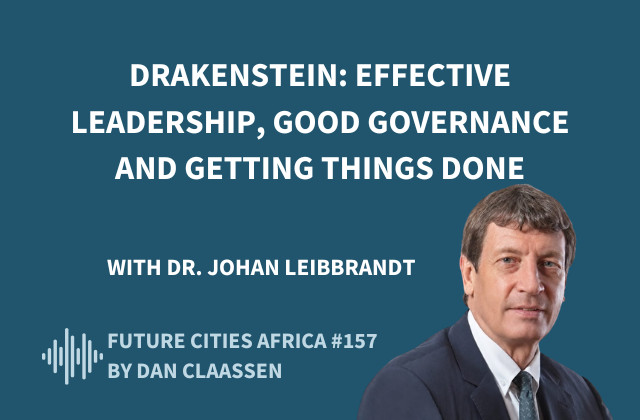
Drakenstein: Effective Leadership, Good Governance and Getting Things Done
Eleven clean audits. South Africa's best secondary city. The Western Cape's best municipality. Drakenstein doesn't talk about good governance - they just do it, year after year. In this episode, City Manager Dr. Johan Leibbrandt unpacks the leadership, disciplines and culture that make consistent performance possible in one of South Africa's most recognised municipalities.
Listen NowUseful Resources
Upcoming Webinars

Recommended Podcasts