The local government performance gap - and how to close it
South Africa's local government reform agenda is moving fast - this edition maps what the international evidence from Kenya, Rwanda and Zimbabwe actually says about what makes municipalities perform, using George Municipality's five consecutive clean audits as the local proof point, with the Draft White Paper comment deadline as the call to action.
Key Takeaways
- George Municipality's five consecutive clean audits - operating under the same MFMA as all 257 municipalities - prove the variable is not the law but how you build the governance engine: risk management integrated from the planning phase, performance scorecards linked to measurable objectives, and internal audit with access to real-time financial data.
- The continental evidence converges on one distinction - capability versus capacity. Staffing a municipality, passing legislation and transferring functions produces activity, not outcomes. Without the capability to execute, none of it works.
- Kenya's 16-year devolution journey mirrors South Africa's fiscal tension: county allocations have grown 118% in nominal terms since 2013/14, yet their share of national revenue has declined. Counties collected only 65.9% of own-source revenue targets in 2022/23. Securing the constitutional architecture is only the beginning.
- Rwanda's IremboGov platform processed over 25 million applications worth approximately US$300 million, reduced service delivery costs by 77.5%, and helped Kigali achieve 101.9% of its own revenue collection targets in 2024/25. Digital transformation is a fiscal infrastructure project - but only when built on strong internal controls and leadership accountability.
- The Draft White Paper on Local Government closed for public comment on 28 May 2026. Its proposals for differentiated, capability-based reform are directly supported by the international evidence - and the November 2026 election transition makes the implementation window shorter than most municipalities recognise.

Business Engineering
Business Engineering (BE) is a South African technology and implementation company specialising in ERP solutions, Artificial Intelligence, mSCOA Compliance, Mobile Citizen App Solutions, Electronic Records, Workflow and & Document Management solutions for local government. As Platinum Sponsor of the International Lessons webinar, BE's work sits precisely at the intersection the panel identified: governance architecture and outcome-driven performance are only achievable when the financial data infrastructure exists to support them.
George Municipality's consecutive clean audits - the reference point for this edition - rest on an architecture where risk management is integrated into the planning cycle, performance scorecards are linked to measurable objectives, and internal audit has access to real-time financial data. That architecture requires the right ERP and financial management systems behind it. mSCOA is not a compliance exercise - it is the data backbone that enables the audit quality and reporting transparency the Auditor-General and National Treasury expect. As municipalities face mounting scrutiny and a November 2026 election transition, the quality of their financial systems is not a back-office concern. It is a governance issue.
George Municipality operates under the same Municipal Finance Management Act as every other municipality in South Africa. It has five consecutive clean audits. The variable is not the law - it is how you build the engine room.
The international evidence is consistent: what distinguishes high-performing municipalities is not better legislation - it is outcome-driven governance. George Municipality's five consecutive clean audits provide the clearest local proof of this. Chief Audit Executive Jean-Pierre Rossouw describes the governance architecture as "almost like the engine room of municipal performance." When the structure is correct and every component works as it should, results follow. George achieved full conformance with international internal audit standards - a benchmark most South African municipalities consider aspirational, while operating under identical legal constraints.
The lesson scales continentally. Kenya's 16-year devolution experiment across 47 counties, Zimbabwe's constitutional minimum revenue transfer to local authorities, and the SADC-wide pattern of decentralisation reform all converge on the same finding: mandates and structures create the possibility; capability and systems create the reality. Miyelani Holeni of Ntiyiso identifies the critical distinction - capability versus capacity. "Capacity without capability produces activity, not outcomes." You can staff a municipality. You can pass legislation. You can transfer functions. None of it works without the capability to execute.
South Africa is navigating its own pivotal moment - local government elections on 4 November 2026, sustained fiscal pressure, and a reform agenda that has produced frameworks faster than implementation. The April 2026 Future Cities Africa and Municipal Edge webinar brought together governance, policy and research practitioners from South Africa, Kenya and Zimbabwe to map what distinguishes municipalities that consistently perform - and what SA's reform journey can draw from the continent. The answers were unusually practical.
From the Continent
Kenya · 16 Years of Devolution
Kenya's devolution is no longer a new experiment - and its maturing challenges look familiar to South African practitioners
When Kenya's 2010 Constitution created 47 semi-autonomous county governments, it embedded devolution as a constitutional principle rather than a political choice. The equitable share - a constitutionally mandated portion of nationally raised revenue - went directly to counties, accompanied by a legal requirement that every county produce a five-year County Integrated Development Plan before public funds could be appropriated. The parallels with South Africa's IDP framework are direct.
Sixteen years in, the model is maturing - and so are its challenges. Counties collected only 65.9% of their own-source revenue target in 2022/23, a shortfall of KES 19.56 billion. The fiscal share going to counties has declined as a percentage of national revenue even as nominal allocations have grown 118% since 2013/14. As Sylvia Nasambu put it: "Our constitution has proven to be resilient, immutable and unamendable - devolution is here to stay." That constitutional anchoring is Kenya's strength. The lesson for SA: secure the architecture, then focus everything on making it work. (Sources: Kenya National Treasury; Division of Revenue Bill 2025; CountyERP.com, 2025)
Rwanda · Digital Governance as Revenue Infrastructure
Kigali's IremboGov platform is the most concrete proof in Africa that digital transformation drives revenue - not the other way around
Rwanda's IremboGov one-stop government portal - launched in 2015 under a public-private partnership - now handles over 100 services across land, health, immigration, taxation and courts. Since launch it has processed more than 25 million applications worth approximately US$300 million in transactions, saving over 100 million working hours. Rwanda's Ministry of Local Government (MINALOC) found in 2025 that services delivered digitally cost 77.5% less than traditional face-to-face channels.
The revenue outcome is equally striking: Kigali City exceeded its own revenue collection targets in 2024/25, achieving 101.9% of collections with 17.4% year-on-year growth. Rwanda is now exporting the IremboGov platform to other African countries. Kudzai Chatiza's call for city-to-city learning is directly supported by this example. The transferable lesson for South Africa is not "copy IremboGov" - it is that digital revenue systems require the same governance pre-conditions Rossouw described for George: strong internal controls, data integrity, and leadership accountability. Technology without governance architecture produces neither the collection rate nor the cost savings. (Sources: MINALOC Survey 2025; govinsider.asia; Modern Diplomacy, August 2025)
The Market View
The gap between international best practice and local outcomes is almost always a systems gap - and that is where the real market opportunity sits.
From Kenya to Rwanda to George Municipality, the consistent pattern is that governance reform delivers results only when underpinned by financial data infrastructure. Risk management integrated into the planning cycle, performance scorecards linked to real-time data, internal audit with access to live financial information - these are systems requirements, not governance aspirations. Rwanda's IremboGov produced 101.9% revenue collection in Kigali in 2024/25 because digital platforms were built on top of strong internal controls and leadership accountability - not instead of them. mSCOA compliance, ERP implementation, and integrated digital revenue platforms are the implementation layer that determines whether international best practice produces local outcomes or remains conference content. The Draft White Paper on Local Government - open for comment until 28 May - proposes exactly the differentiated, capability-based reform agenda that this evidence supports. For companies servicing the municipal technology and financial systems space, the alignment between the White Paper proposals, November 2026 election transition pressure, and the international evidence base creates the clearest demand signal in years.
Upcoming Webinars
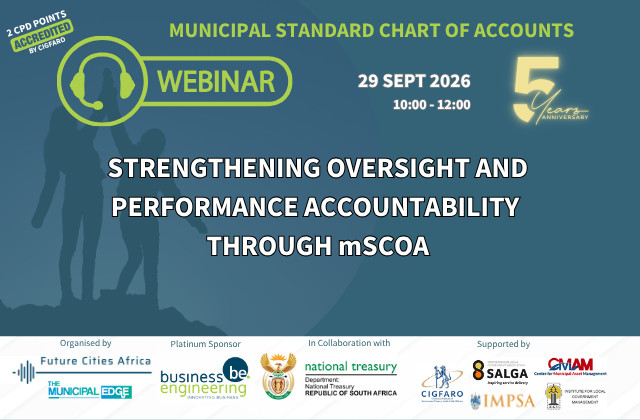

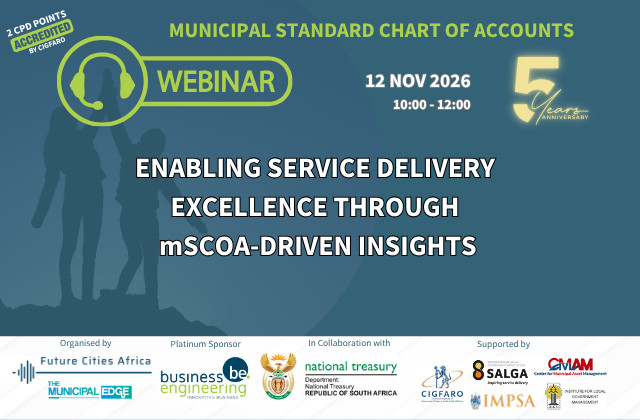
Recommended Podcasts

